
Industrial Technology

NC swings to profit, Nexon beats expectations as Krafton struggles
Korean game developers have reported mixed third-quarter earnings. NC returned to profitability from a year earlier, while Nexon defied market pessimism with solid revenue from its live service games. Krafton, meanwhile, saw its operating profit decline as revenue from PUBG: Battlegrounds (PUBG) failed to keep pace with rising costs associated with its business diversification efforts. NC announced its third-quarter earnings Wednesday, reporting sales of 686.5 billion won ($514.2 million) and an operating profit of 119.6 billion won. Revenue surged 91 percent year-on-year, while the company swung to an operating profit from a loss of 750 million won in the same period last year. Overseas sales accounted for 54 percent of total revenue, marking the fifth consecutive quarter of growth in their share, as the company continued to expand its global revenue base, particularly in North America and Europe. Notably, revenue from mobile casual games increased from the previous quarter to 171.9 billion won. The segment accounted for 25 percent of total revenue, contributing to the diversification o

LG Innotek earns top cooperation rating for 10th consecutive year
LG Innotek said Wednesday it received the highest rating in the 2025 Win-Win Growth Index assessment conducted by the Korea Commission for Corporate Partnership, marking its 10th consecutive year at the top level. The index evaluates companies' efforts to promote mutually beneficial partnerships with suppliers and classifies them into five grades, ranging from outstanding to very inadequate. LG Innotek has maintained the highest possible rating since the 2016 assessment, reflecting its sustained efforts to strengthen partnerships with suppliers. Recognizing that suppliers' competitiveness directly contributes to its own, the company has steadily expanded its support programs to address changing business conditions. Its support programs span financing, production innovation, smart factory development, environmental, social and governance (ESG) management, workforce training, artificial intelligence (AI), industrial safety and technology protection. The company operates a 143 billion won ($107 million) supplier partnership fund, established in 2010 to provide loans at below-market interest

AMD teams up with Samsung Electronics on next-generation embedded processors
Advanced Micro Devices (AMD) is collaborating with Samsung Electronics on its next-generation embedded processors, industry officials said Wednesday. The US semiconductor company unveiled its sixth-generation AMD EPYC Embedded 9006 on Tuesday (local time), incorporating Samsung's enterprise memory and storage solutions, they said. "As memory and input/output technologies advance, manufacturing test environments must also evolve to meet growing performance and bandwidth requirements," Choi Jang-seok, a senior Samsung Electronics official, said. "We look forward to working with AMD to bring these capabilities to our manufacturing test infrastructure." AMD's new processors deliver up to 1.8 times the throughput of the previous generation. The processors are designed for industrial applications requiring high-performance computing. Through the collaboration, Samsung Electronics aims to secure the computing power, memory bandwidth and high-speed data processing capabilities needed to validate next-generation memory performance.

FTC to fine 15 firms $1.2 bil. for rigging gov't bond bids
Korea's fair trade watchdog said Wednesday it has decided to impose 1.62 trillion won ($1.2 billion) in fines on 15 financial companies for colluding in government bond auctions for more than three years. The Fair Trade Commission (FTC) said the firms, all primary dealers comprising 10 brokerage houses and five banks, exchanged information on bidding yields and volumes through phone calls and messaging apps regarding 150 auctions between January 2020 and June 2023. It marked the largest fine ever imposed by the FTC in a single case, surpassing the previous record of 1.03 trillion won levied on Qualcomm for unfair practices in 2016. In 145 of those auctions, the companies went beyond exchanging information to reach agreements on specific bidding yields or volumes, constituting bid rigging, the watchdog said. "Dealers in charge of bidding at the 15 companies exchanged information on bidding volumes or yields on auction days, routinely engaging in collusion, with agreements sometimes reached within seconds," the FTC said. The watchdog noted such collusion constitutes a serious violation as g
Amid Nvidia saga, T-Head IPO a crucial test for Alibaba – and China’s AI ambitions
Alibaba Group Holding’s planned Hong Kong listing of its semiconductor design arm, T-Head, is poised to reshape China’s artificial intelligence hardware arena while unlocking billions of dollars in trapped valuation for the tech titan, according to analysts. The proposed spin-off serves as a test of whether the sum of Alibaba’s parts is worth significantly more than its current market valuation. Alibaba’s Hong Kong-listed shares slipped about 1 per cent to HK$100.60 on Wednesday, the day...
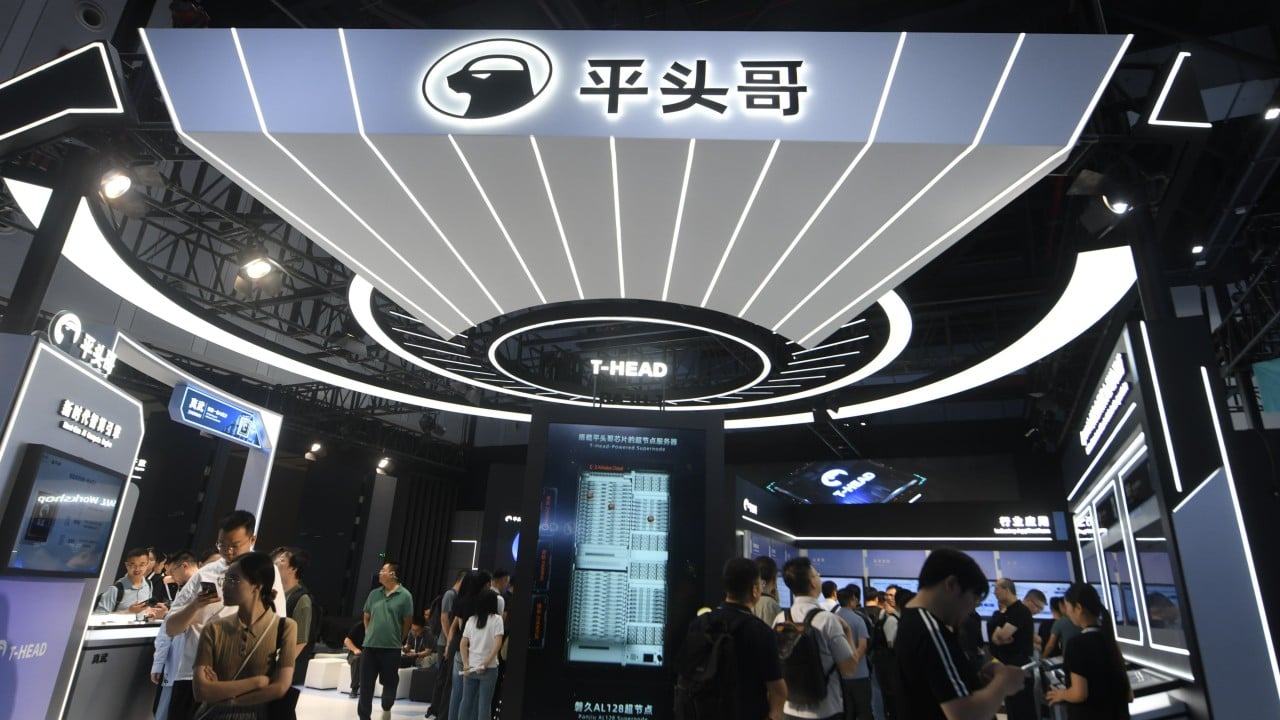
Alibaba readies T-Head chip IPO as Hong Kong frenzy cools
Alibaba has applied to list chip-design unit T-Head in Hong Kong, as the Chinese tech giant braves a cooling initial public offering (IPO) market to raise funds for artificial intelligence (AI) ambitions. The Hong Kong stock exchange has approved the proposed separation and a confidential listing application was filed in September, Alibaba said in a statement on Tuesday. T-Head, which provides full-stack data centre chips, will remain a unit of the company. Alibaba also owns the South China...
Airwallex to invest more than S$2 billion in Singapore, grow headcount here to over 1,000
The city-state is one of the company’s two ‘global-headquarters’, alongside San Francisco

Nvidia CEO Jensen Huang’s affair: everything you need to know
We have put together stories from our coverage of Jensen Huang’s affair and its potential repercussions. If you would like to see more of our reporting, please consider subscribing. 1. Could Jensen Huang’s affair become another ‘spy balloon’ saga for US-China ties? China hawks in Washington could weaponise allegations that Nvidia CEO Jensen Huang was targeted by Chinese intelligence, despite denials from Beijing, Chinese experts warn. 2. ‘Adding fuel to fire’: how Nvidia CEO’s troubles could...

Leica’s Cine Play 1 Plus Projector: Brighter, smarter 4K laser for 300-inch home cinema
Leica’s latest 4K laser projector promises brighter pictures, improved contrast and screen sizes of up to 300 inches, without requiring a dedicated home cinema room.
What Taiwanese chip giant TSMC gains from taking stakes in OpenAI and Anthropic’s AI race
Taiwan Semiconductor Manufacturing Company’s (TSMC) move to take equity stakes in both OpenAI and Anthropic will give the world’s largest contract chipmaker direct financial ties to the frontier AI labs driving demand for its business. Its board on Tuesday authorised up to US$500 million to buy Anthropic common shares at its initial public offering (IPO) price, and up to US$500 million to buy preferred shares in OpenAI. Directors separately approved up to US$500 million to establish a dedicated...