
Most Recent

China's 'mala' sauce breaks Korea's culinary boundaries
"Mala" is enchanting Korean palates across the domestic food industry. The tongue-numbingly spicy seasoning that is a traditional favorite in China's Sichuan province has become a popular ingredient for dishes beyond just Chinese cuisine, spreading to Korean and Western dishes in both the dine-in and takeout scenes. Since its introduction to Korea in the early 2010s, the popularity of mala among Korean consumers began to grow more widespread in 2018, and has been on a consistent rise since. At Google Trends, online searches for “malatang" (mala-based hot pot) this month jumped 350 percent from 2022, while "mala rosé" (mala and creamy tomato sauce) jumped 250 percent during the same period. Korean's frenzy over mala has been evident in the country's dine-in landscape as well. Tanghuo Kungfu, the largest Korean malatang franchise, posted sales of 25.5 billion won ($19 million) last year, nearly tripling from 2022. Chunli Malatang enjoyed a sales increase of 134 percent from 2023, while Lahongbang saw a 32 percent rise from the previous year. This year, McDonald’s Korea, Binggrae, Otok

Citibank Korea names corporate banking expert as next CEO
Citibank Korea has tapped Kim Kyoung-ho, its head of corporate banking, as its next CEO, marking the lender’s first leadership change in six years, the bank said Wednesday. The bank’s executive recommendation committee named Kim as the sole finalist at a meeting, Tuesday. If approved by the board and shareholders, he will succeed Yoo Myung-soon, who has led Citi since 2020 as its first female CEO. Her term expires Oct. 27. The committee described Kim as “a corporate banking expert with extensive experience serving large corporations and financial institutions,” citing his track record, deep knowledge of client relationships and the Korean market, as well as his understanding of risk management and internal controls. Kim joined Citibank Korea in 2001 and has held a series of senior roles in corporate banking, including large corporate banking and financial institutions coverage, before being promoted to an executive vice president in 2021. His appointment comes as Citi continues to reshape its Korean business following its exit from consumer banking. With corporate clients now at

Bank CEOs on edge over year-end reappointment as governance scrutiny grows
With the terms of 54 top executives at major financial holding companies’ affiliates set to expire at the end of the year, including the CEOs of all five major commercial banks, the government is stepping up pressure on financial groups to make their leadership succession more transparent and address any procedural shortcomings, according to industry officials Wednesday. Financial Supervisory Service (FSS) Gov. Lee Chan-jin made the call at a meeting with the chairmen of eight financial groups — KB, Shinhan, Hana, Woori, NH NongHyup, iM, BNK and JB — at his agency's headquarters in Seoul, Wednesday. CEO appointments at their subsidiaries, Lee said, should be “a transparent and fair process for identifying the right candidates based on their capabilities, without being swayed by particular factions or personal relationships.” Holding companies that still lack what the FSS considers basic safeguards, including clearly defined qualifications for the top job and a minimum period for assessing candidates at each stage, should address those gaps before launching their appointment pr

Korea's first US investment hinges on long-term power buyers
As Korea confirmed a natural gas-fired combined-cycle power plant in Encinal, Texas, will be the first project under its $200 billion strategic investment commitment to the United States, power purchase agreements (PPAs) with potential power buyers are emerging as a key factor in determining the project’s commercial viability. In a National Assembly briefing on Tuesday, Industry Minister Kim Jung-kwan said the project will be worth $22.3 billion, with planned generating capacity reaching 6.3 gigawatts. The project will initially build a 1.4-gigawatt gas turbine power plant to assess actual demand and economic viability, before gradually expanding it with 4.9 gigawatts of more efficient combined-cycle generation capacity. The project will be funded entirely by Korea, while ownership will be split equally between Seoul and Washington. Electricity generated from the plant is expected to power artificial intelligence (AI) data centers in the region. In selecting the gas plant as the first project, the government considered “commercial reasonableness,” stipulated as a key condition in
Grab executives buy back shares after stock hits 3-year low on Atome deal
‘I have put my money where my mouth is... I believe in our strategy and our direction,’ says CEO Anthony Tan
PPAs emerge as key viability factor in Korea's 1st US investment project
As Korea confirmed a natural gas-fired combined-cycle power plant in Encinal, Texas, will be the first project under its $200 billion strategic investment commitment to the United States, power purchase agreements (PPAs) with potential power buyers are emerging as a key factor in determining the project’s commercial viability. In a National Assembly briefing on Tuesday, Industry Minister Kim Jung-kwan said the project will be worth $22.3 billion, with planned generating capacity reaching 6.3 gigawatts. The project will initially build a 1.4-gigawatt gas turbine power plant to assess actual demand and economic viability, before gradually expanding it with 4.9 gigawatts of more efficient combined-cycle generation capacity. The project will be funded entirely by Korea, while ownership will be split equally between Seoul and Washington. Electricity generated from the plant is expected to power artificial intelligence (AI) data centers in the region. In selecting the gas plant as the first project, the government considered “commercial reasonableness,” stipulated as a key condition in
Chinese AI firms fall on report of DeepSeek, Moonshot probe
Shares of Z.AI and MiniMax decline as much as 7.4% and 6.3% in Hong Kong, respectively
Alibaba to add data centers in Europe, Middle East amid AI push, US-China tech race
It is increasingly going head-to-head with Western rivals Amazon and Alphabet in regions beyond Asia
Alibaba to add data centres in Europe, Middle East amid AI push, US-China tech race
It is increasingly going head-to-head with Western rivals Amazon and Alphabet in regions beyond Asia
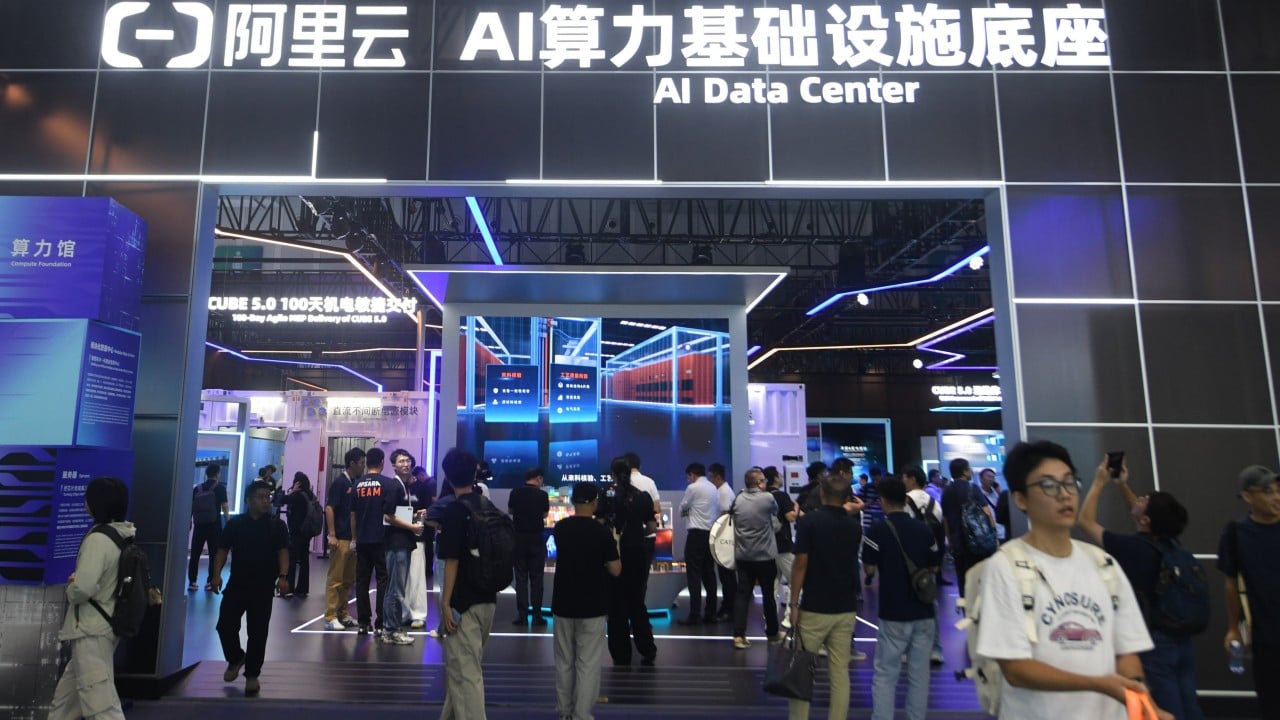
Alibaba Cloud set to open new data centres in Europe next year as overseas push gains pace
Alibaba Cloud, Alibaba Group Holding’s cloud business unit, is set to launch data centres in Turkey, Finland and the Netherlands over the next 12 months, speeding up an overseas push as it seeks to win enterprise customers through its “full stack AI capabilities” spanning chips, cloud infrastructure and multimodal models. The first of these new data centres will open in the Netherlands in October. The cloud unit will also add to existing data centre capacity in Malaysia, Germany, the United Arab...