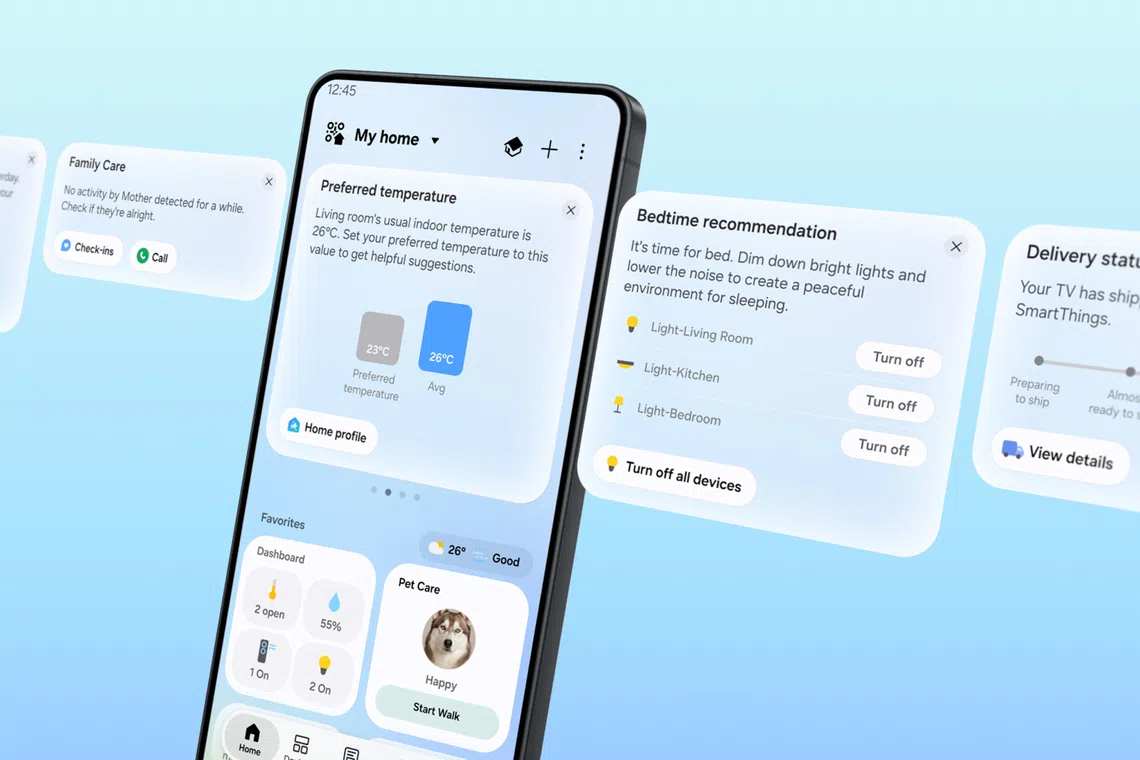
The wide-ranging launch also covers air purifiers, floor cleaners and hair-care devices, alongside the camera-equipped CameraJet toothbrush.
Sep 17, 2026
Huawei Technologies said on Thursday that it would launch its next-generation artificial intelligence chip in the first quarter of 2027, moving the target launch forward by nine months as the firm aggressively expands its ecosystem amid China’s self-sufficiency push. David Wang Tao, rotating and acting chairman for Huawei, said on Thursday that the Ascend 960DT chip, an AI chip designed for model training, “with performance doubling”, would be “ready in the first quarter of 2027”, three quarters...
Singtel’s AI Pass gives eligible learners access to six premium AI tools for up to six months, as Singapore expands its national push to build practical AI skills.
Huawei Technologies on Thursday unveiled its latest Atlas 960 SuperPoD computing cluster and an upgraded version of its UnifiedBus interconnect technology, key components of the Chinese tech giant’s strategy to build advanced artificial intelligence systems despite US semiconductor-related restrictions. At the Huawei Connect 2026 conference in Shanghai, the Shenzhen-based firm introduced near-packaged optics (NPOs) – a placement structure enabling higher speeds and lower energy use – to the...
This new phone display breakthrough raises the bar on resolution and refresh rates to a new gold standard.
Sep 16, 2026
Unionized workers at South Korean steelmaker POSCO began a second partial strike Wednesday after failing to narrow differences with management in wage negotiations. The 120-hour walkout began at 7 a.m. at POSCO's steel plants in Pohang and Gwangyang in southern South Korea, the union said. "We will call off the strike before the end of the five-day walkout if the company comes up with an acceptable proposal," union spokesperson Yi Jae-hyuk said by phone. POSCO has about 17,000 employees, including around 10,100 union members. The strike follows a 48-hour walkout that began at 7 a.m. last Wednesday and involved 120 workers, marking the first strike by POSCO workers since the company was founded in 1968. The union said the second strike would cause inevitable disruptions as about twice as many workers are participating compared with the first strike. POSCO said, however, that there would be no major disruption to plant operations, with about 60 workers each from its Pohang and Gwangyang plants expected to join the strike. The union has demanded a 7.1 percent increase in base pay, a performanc
SK hynix’s production workers’ unions on Wednesday approved a revised tentative agreement reached between their representatives and management, under which employees will receive half of their performance bonuses in cash and the other half in company shares, concluding this year’s wage and collective bargaining negotiations without a labor dispute. According to SK hynix, the two production workers’ unions at the company approved the tentative agreement with a 57.08 percent vote in support. More than 15,000 of the unions’ 16,000 eligible members took part in the vote. The two unions respectively represent production workers at the company’s Icheon plant in Gyeonggi Province and Cheongju plant in North Chungcheong Province. A key feature of the agreement is that half of the performance bonuses, known as excess profit-sharing, will be paid in cash, while the other half will be paid in the form of treasury shares. The revised agreement replaces an earlier tentative deal that called for 60 percent of the bonuses to be paid in treasury shares and the remainder in cash, which the t
S-Oil CEO Anwar Al-Hejazi, second from left, prepares “songpyeon,” traditional Korean rice cakes, during an event at the oil refiner’s headquarters in Seoul, Wednesday, with company employees, children from nearby day care centers and Saudi Arabian students. The participants also delivered 50 million won ($36,000) worth of songpyeon and Chuseok gifts to low-income families living near the headquarters. Courtesy of S-Oil
The Walt Disney Company’s long-standing legacy in animation, entertainment and consumer products is entering a new chapter in Korea, where the company sees the country’s global content power as a new source of inspiration for next-generation consumer experiences. Walt Disney Company Korea on Wednesday unveiled its new campaign, “ICONS UNLEASED: Global Icon Becomes Center of New K-Wave.” It builds on K-pop, Korean heritage and original Korean content, with plans to develop new businesses from each area. Disney Korea will collaborate with K-pop management companies like Kakao Entertainment, SM Entertainment, HYBE and Starship Entertainment to combine their artists’ unique worldviews with stories from Marvel to create new fan experiences. The company cited the successfull collaboration between G-Dragon’s fashion lineup PEACEMINUSONE and Disney’s "Toy Story” franchise in July to introduce new toys, apparel and goods as precedent. Korean cultural heritage will be combined with Disney intellectual properties (IP) to introduce new region-based tourism products for global touris
Korean cybersecurity firm Ahnlab said Wednesday it plans to invest 100 billion won ($73.14 million) over the next three years in an effort to restructure its business around subscription-based services. Such plans were announced at a press conference in Seoul as it vowed to transform the company into an "artificial intelligence native" cybersecurity firm. According to the company, the investments will focus on building artificial intelligence (AI) infrastructure, as well as improving its research and development capabilities and attracting AI-related talent. Building on this, the company also plans to triple its sales from 300 billion won this year to 1 trillion won by 2035, Ahnlab's Chief Executive Officer (CEO) Kang Suk-kyoon explained. "We need to grow by an average of 15 percent every year to attain that goal, but given our growth trend, we think such a goal is achievable," he said, noting the company could consider carrying out merger and acquisition deals or new investments to scale up. Ahnlab also plans to expand its overseas sales to 30 percent by 2035 from the current 10 percent
LG Energy Solution and Hyundai Motor Group are distancing themselves from the legal actions of workers against the U.S. government over their detention during last year’s immigration raid at the companies’ joint battery plant in Georgia. An LG Energy Solution official told The Korea Times Wednesday that the company was not aware that employees were taking legal action until media reports emerged Tuesday night. The official added that the company would not get involved because the legal actions were based on individual decisions by the workers, and the company is not tracking who is joining the campaign. An official at Hyundai Motor Group also said none of the company’s employees were among those detained at the time, adding that it is not involved in legal action taken individually by workers from partner companies or those dispatched to the site. A day earlier, CNN reported that more than 300 Korean workers detained during the raid started filing administrative claims with nine federal agencies, including the Department of Homeland Security, Immigration and Customs Enforcement (I
The industry ministry's planned briefing to the National Assembly this week on Korea's investment project in the United States has been delayed for undisclosed reasons, sources said Wednesday. According to the sources, the Ministry of Trade, Industry and Resources originally planned to hold a closed-door parliamentary briefing Thursday on Korea's first investment project in the U.S. under a bilateral agreement reached last year. In October, Korea and the U.S. reached an agreement on Seoul's $350 billion investment pledge made in return for lower U.S. tariffs. The investment will comprise $150 billion for shipbuilding cooperation and $200 billion for projects in various strategic sectors. The industry ministry, however, asked the parliament's trade and finance committees to postpone the scheduled briefing without providing details on the reasons. Observers said the delay apparently came as Seoul and Washington failed to reach an agreement during the final stages of negotiations. "Negotiations with the U.S. are currently under way," an official from the industry ministry said. The delay is e
Woori Bank’s specialized prepaid card for foreign visitors, dubbed the “NOL World Card,” reached the 10,000-issuance mark within just three months of its market debut, the bank said Wednesday. The card, jointly introduced by the bank, travel platform operator NOL Universe and fintech company Kona I, aims to make local financial transactions and daily shopping more convenient for international travelers amid the surge in inbound tourism and the corresponding need for easy-to-use local payment options. Data from the Ministry of Culture, Sports and Tourism show that foreign arrivals reached 10.71 million in the first half of this year, representing a 23.1 percent year-on-year increase. However, short-term visitors have long struggled with local financial barriers, as opening bank accounts or securing domestic credit and debit cards can be difficult, often leaving them reliant on cash exchanges or international payment methods. Designed to address these issues, the NOL World Card can be collected immediately upon landing at Woori Bank exchange counters at Incheon International Airport
KT, one of Korea's major telecommunications service providers, has joined forces with the Korea Institute of Science and Technology Information (KISTI) to open the nation's first 400-gigabit-per-second (Gbps) international dedicated circuit linking Korea and the United States, creating a faster route for massive research datasets. The circuit connects KISTI’s headquarters in Daejeon with Chicago, a major hub for research networks serving North America and Europe, KT said Wednesday. The new connection quadruples bandwidth from the previous 100 Gbps and is designed to support faster, more stable transfers for international scientific collaboration. Demand for cross-border data exchange has grown as research involving artificial intelligence (AI), large-scale science and astronomy increasingly depends on vast volumes of data, KT said. The new network is expected to accelerate transfers of large research datasets, strengthen global connectivity for Korea’s national research network and expand support for international collaborative research. KT and KISTI also completed technical tests aim
Stella Artois is introducing Pure Gold, a new premium lager in Korea that combines zero sugar and zero gluten with a lower alcohol content of 4.2 percent. The Belgian beer brand said Wednesday that Pure Gold, its first new lineup introduced in Korea, is designed around a lighter drinking experience while retaining a delicate, clean flavor. The launch makes Korea the first market in Asia to receive Pure Gold, which was first introduced in Brazil and will begin appearing in stores and restaurants nationwide from late September. Stella Artois said Pure Gold contains about 16 percent less alcohol than its existing beer. The new lager will be available in 330-milliliter and 500-milliliter cans and 500-milliliter bottles. Bottle sales will begin primarily at premium restaurants in Seoul and the capital region before expanding to other restaurants, while online platforms will offer assorted packages. A 500-milliliter eight-can package will go on sale Sept. 28, followed by a package containing eight 500-milliliter cans and a dedicated Stella Artois chalice on Oct. 15. The packaging takes its cues
Korea’s Rural Development Administration (RDA) signed a memorandum of understanding (MOU) with Uzbekistan’s Ministry of Agriculture on Monday to support sustainable agricultural development and expand bilateral cooperation. The RDA, an agency under the Ministry of Agriculture, Food and Rural Affairs, said the agreement was signed ahead of the Korea-Central Asia Summit in Seoul on Wednesday. The MOU aims to help Uzbekistan train agricultural specialists by drawing on Korea’s farming technologies and the RDA’s experience in structured training programs. Under the agreement, the two countries will cooperate to improve agricultural productivity through advanced technologies and sustainable farming practices. They will also expand knowledge-sharing, technical guidance and consulting, professional training and exchanges among agricultural institutions and experts. The RDA will help develop customized training programs that reflect Uzbekistan’s farming conditions and needs. It also plans to strengthen the capabilities of researchers, agricultural workers and farmers through exchanges
Mars Korea is integrating Kellogg’s cereals and Pringles into its domestic lineup, establishing a consolidated consumer goods powerhouse spanning snacks, breakfast foods and pet care. The integration follows Mars’ acquisition of Kellanova, the parent company of Nongshim Kellogg, in December 2025, Mars Korea said Wednesday. Mars Korea held its first all-employee town hall Tuesday, marking the first official gathering since its Korea operations and organizations began operating under a unified structure. Lee said the change marked a milestone as Mars moved into a new phase in Korea and urged employees to build on the strengths of each business and brand to create greater synergies. The expanded portfolio adds Kellogg and Pringles to Mars Korea’s existing brands, which include Snickers and Twix in chocolate, Eclipse in gum and mints, and Cesar, Whiskas and Greenies in pet care. The combined business now spans chocolate, gum and mints, cereal, snacks and pet care, broadening Mars Korea’s presence across consumer categories. Mars said the integration is intended to create a unified oper
BGF Retail has opened what it calls Korea’s largest logistics center for the convenience-store industry, placing a 260 billion won ($187 million) investment at the center of its effort to remake regional distribution and support overseas expansion. The company held a completion ceremony Wednesday at its new facility in Gurang-dong, Gangseo District, Busan, with BGF Group Chairman Hong Seok-jo, BGF Retail Vice Chairman Hong Jung-kook and Busan Mayor Jeon Jae-soo among those attending. Built on a 47,186.8-square-meter site, the center has 128,072.65 square meters of floor space, making it BGF Retail’s largest logistics investment to date. BGF Retail began planning the facility after signing an investment agreement with Busan in 2021 and started construction in 2024, completing the project on July 14 after roughly two years of construction. The center is designed to reorganize deliveries across Busan and the Yeongnam region while serving as a major distribution point for CU stores. Its location near Busan New Port will also allow BGF Retail to handle import and export logistics as it exp
For GS, building AI data centers is becoming less about finding more power and more about finding what comes next, gathering seven startups Tuesday to pitch technologies spanning electricity, memory, cooling and computing. GS Ventures held its 2026 Tech Day at GS Tower in Gangnam, Seoul, bringing together six companies in its investment portfolio and one additional startup focused on artificial intelligence (AI) data center technologies. Executives from GS Energy, GS Caltex, GS E&C, GS E&R and GS Global attended, along with representatives of participating startups. The companies presented technologies covering much of the infrastructure needed to keep AI data centers running, from stable power supplies to graphics processing unit (GPU) cloud operations. Synergy introduced a hydrogen fuel cell solution for data centers, drawing on technology developed for ships and maritime transportation, while Exina presented intelligent memory based on Compute Express Link, or CXL, designed to ease data-processing bottlenecks. CoolMicro and SDT presented liquid-cooling systems, with one using direct-to
SK Telecom said it signed a partnership with global security company F5 to expand cooperation on artificial intelligence (AI) cloud security, aimed at strengthening the carrier's ability to defend against web and API attacks as well as distributed denial-of-service (DDoS) and bot attacks. Under the deal, SK Telecom will act as both a value-added reseller, which resells F5 products with added services or technology, and a managed service provider, which uses F5 products to deliver managed IT services to customers — making it F5's first domestic managed service partner for its software-as-a-service security platform. F5, headquartered in Seattle, is a global leader in multicloud application and API security, providing solutions to more than 90 percent of Fortune 500 companies. Its software-as-a-service-based security platform, F5 Distributed Cloud, helps companies protect applications and APIs across multicloud environments as part of their digital transformation. SK Telecom said the partnership responds to the rapidly growing AI market and tightening security regulations. The market fo
Korea Hydro & Nuclear Power (KHNP) has won the Technology Transfer Award (TTA) from the Electric Power Research Institute (EPRI), a U.S.-based nonprofit power research consortium, for its technological achievements in the wind power sector. The award recognizes the results of a wind power performance improvement project jointly conducted by KHNP and EPRI. As part of the project, KHNP developed an advanced engineering technology that uses machine learning to detect abnormal turbine behavior, identify the causes of performance degradation and develop measures to improve efficiency. KHNP applied the technology to wind farms operating in the United States, using it to identify underperforming turbines, analyze the causes of their performance declines and develop plans to improve efficiency. KHNP plans to integrate the software developed through the project into its operations and further develop it as an in-house technology. The move is expected to reduce the company's reliance on external engineering services and maintenance costs while improving the performance and efficiency of its overse
Standard Chartered (SC) Bank Korea is offering first-time customers an interest rate premium of up to 4 percent on its Hi Account, as part of a promotional campaign running through the end of the year, the lender said Wednesday. The product is available for sign-up through Dec. 31, while the special rate offer — 3.4 percentage points regardless of balance — will remain in effect through Jan. 31, 2027, meaning those who join earlier will benefit from the higher rate for a longer period. The offer is open to customers who have been newly registered with SC Bank Korea for 31 days or less, as well as existing customers who have not held won- or foreign-currency demand deposit, savings or installment savings accounts with the bank during the previous year. The Hi Account has a base rate of 0.1 percent a year. Outside the promotional offer, customers can also qualify for additional rate incentives, including 0.1 percentage point for opening the account through a partner channel, 0.2 percentage points for consenting to marketing communications and 0.2 percentage points for Priority Banking
A high-level delegation from the Abu Dhabi Chamber of Commerce and Industry (ADCCI) is visiting Korea from Sept. 15-17, as part of the emirate's continuing effort to strengthen ties with major trading partners and economies. The visit builds on the special strategic partnership between Korea and the United Arab Emirates established in 2018, with the delegation set to explore expanded cooperation in artificial intelligence (AI), advanced manufacturing, energy, water resources, health care, education, space and agricultural technology. More than 88 public and private organizations are represented in the delegation, including the Abu Dhabi Department of Economic Development (ADDED), Abu Dhabi Global Market (ADGM), the Abu Dhabi Investment Office (ADIO), Abu Dhabi Customs, Hub71, Abu Dhabi Police, Sheikh Shakhbout Medical City, Khalifa Economic Zones Abu Dhabi, Emirates Global Aluminium, Etihad Airways, Masdar City, Core42 and financial services and investment banking platform Al Liwan. Shamis Ali Khalfan Al Dhaheri, chairman of the Abu Dhabi Department of Community Development and second v
Korea "cannot afford" to slow down its artificial intelligence (AI) progress, the country's science minister said Wednesday, but noted the emphasis should be put on responsible development rather than the speed of advancement itself. "It is an entirely different matter for a country already ahead to adjust its pace, than for a nation that is catching up while simultaneously having to create new markets to slow down," Science Minister Bae Kyung-hoon wrote in a social media post. "We cannot afford to slow down the pace of AI development," he stressed. The minister said the gap between countries that have secured AI frontier models approaching the level of human intelligence and those who have not could eventually extend beyond merely a technological gap and into other areas, such as the country's industrial competitiveness, national security and even its future growth. But Bae expressed a cautionary approach to unconditional acceleration, stressing efforts to ensure safety and trust should also come in tandem with the pace of technological development. The science minister's comments come a
China is bracing for a potential massive sell-off of a high-profile artificial intelligence chip stock on Thursday, when a lock-up period affecting 14 million shares in MetaX Integrated Circuits is set to expire. Analysts expect MetaX to face “significant selling pressure” when the restricted shares are released for trading, after the expiry of a similar lock-up period for shares in fellow AI chip firm Moore Threads last week sparked an avalanche of sales that wiped nearly 49 billion yuan...
Apple's iPhone 18 Pro looks almost identical to last year's model. But don't let the familiar design fool you. This is one of the most significant internal upgrades Apple has made in years, and it's the camera doing the heavy lifting.
China’s Moonshot AI has attracted global investor interest spanning Europe, Asia and the Middle East, people familiar with the matter say, as international capital scrambles for access to Chinese frontier artificial intelligence labs, betting on their high-stakes race against US rivals. The Beijing-based developer of the Kimi family of AI models has seen mounting interest from overseas players ranging from European investment firms to Middle East family offices, with some seeking indirect...
Meta One consolidates the existing subscription plans for WhatsApp, Facebook and Instagram, and adds even more AI tools to the mix.
StarCraft is finally returning, but not as a real-time strategy sequel many fans were expecting.
Razer has brought down Sensa haptics from the Kraken V4 Pro, and put it into the body of a Kraken V4 X.
With less than a month to go before we see another Amazon Prime Big Deal Days event, here is what you need to know about the sale.
According to its specifications for the Mainland Chinese market, the phone will likely come with triple 200MP cameras and a powerful MediaTek chipset.
The Mac mini-sized computer is designed for developers and businesses that want to run AI models locally.
Sometimes, last-minute in-store shopping might be your best option.
Sep 15, 2026
OpenAI chief executive Sam Altman backed an AI slowdown on Saturday. Now he says the public should be able to put their faith in AI firms to act responsibly without strings attached.
Adaptations for Crazy Taxi and Yakuza prequel Stranger than Heaven will be live-action, while the Sonic adaptation is set to be an animated series for kids.
With Hoban Group’s stake in Hanjin KAL nearly matching that of Hanjin Group Chairman Cho Won-tae and his interested parties, Delta Air Lines and Japan Airlines (JAL) are emerging as potentially crucial allies in maintaining the Cho family's control of Korean Air. As Hoban closes in on Cho’s stake in Hanjin KAL, Korean Air’s controlling shareholder is counting on its old ally, Delta Air Lines, to help hold the line. Delta owns a 14.9 percent stake in Hanjin KAL, making it one of the largest shareholders and a key pillar of Cho’s shareholder base. The U.S. carrier has also maintained a deep strategic relationship with Korean Air for years, and is widely considered to stand in favor of Cho’s leadership. That support could become increasingly important as the ownership structure tightens. Hoban now owns 20.15 percent of Hanjin KAL, just 0.42 percentage point below Cho and his related parties. The gap is small enough to turn every major shareholder into a potential kingmaker, particularly as Korea Development Bank (KDB) still holds a 10.58 percent stake and has yet to decide when an
Kim Sang-yeol, founder and former chairman of Hoban Group, has built the company into one of Korea’s most aggressive investors, with his latest bet on Korean Air bringing Hoban’s Hanjin KAL stake nearly level with that of the airline’s controlling shareholder. Hoban Group has so far amassed a 20.15 percent stake in Hanjin KAL, the parent company of Korean Air, putting it just 0.42 percentage point behind Hanjin Group Chairman Cho Won-tae and his related parties, which collectively own 20.57 percent. That narrow gap puts Kim in a position to challenge the balance of power at Korea’s flagship airline — particularly if Korea Development Bank (KDB) decides to sell its 10.58 percent stake. The state-run bank has yet to decide how to sell its stake in Hanjin KAL. The decision may determine who holds the upper hand in the management rights for the integrated airline that is scheduled to launch on Dec. 17 following Korean Air's takeover of Asiana Airlines. Hoban has expanded far beyond its housing construction roots through a string of acquisitions and investments, including Taihan Cab
Hyundai Motor’s autonomous driving road map is putting its ability to keep pace with Tesla under scrutiny, as the U.S. automaker rapidly gains stronger ground in Korea’s electric vehicle (EV) market. Last week, Hyundai Motor Group’s self-driving arm — 42dot — said it will introduce cars with Level 2+ autonomous driving technology based on Nvidia’s platform in the first half of 2028, followed by Level 2++ technology later that year. Vehicles equipped with the carmaker’s proprietary Atria artificial intelligence (AI) system will also be mass-produced in the second half of 2029, according to 42dot. Under the road map, the automaker seeks to close the gap with Tesla and other overseas autonomous driving leaders. But the timeline for Hyundai Motor's self-driving commercialization still leaves much to be desired, as Tesla has already turned into a consumer-facing product. Tesla’s Full Self-Driving (FSD) Supervised system is already available in Korea in limited form, although regulatory approval for its broader domestic operation remains a key hurdle. Tesla has also been expand
Hyosung Heavy Industries has secured 386.5 billion won ($277 million) worth of ultra-high-voltage transformer orders from two major U.S. Big Tech companies this month, strengthening its position as a key power infrastructure supplier amid the rapid expansion of artificial intelligence (AI) data centers. The company said Tuesday that the transformers will be installed at newly built AI data centers in the northern and southern United States. The orders include 220 billion won worth of 765-kilovolt transformers and 166.5 billion won worth of 345-kilovolt transformers. The equipment will supply electricity to power-intensive data center facilities. The latest deals reflect Hyosung Chairman Cho Hyun-joon’s yearslong efforts to establish a local production and solutions network in the U.S. Cho has described the surge in demand for power infrastructure as a “once-in-60-years supercycle” driven by AI. He has set a goal of making Hyosung Heavy Industries one of the world’s top three power equipment companies within five years by offering a broad portfolio ranging from transformers and ci