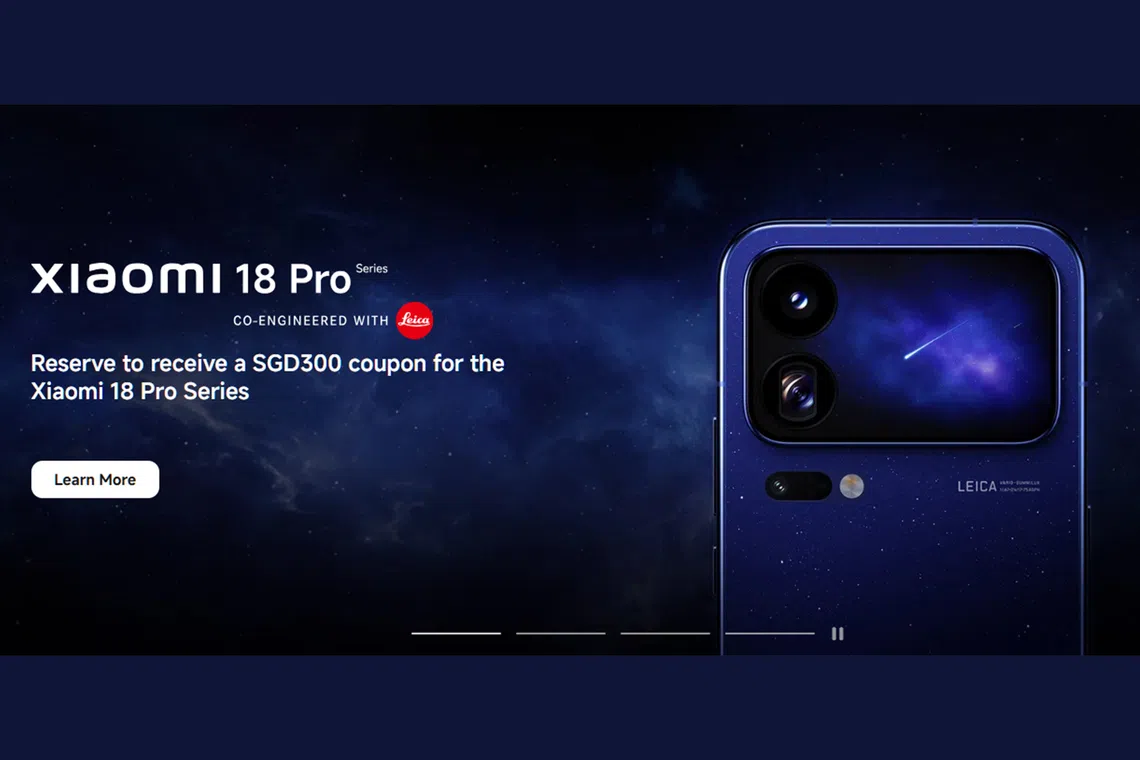
Xiaomi is adding more apps to its rear OLED display, although using Google Maps on the smaller screen might be a different story.
Nov 17, 2026
Naver and Kakao are doubling down on local business listings, user reviews and services linking place discovery to bookings and payments to defend their positions in Korea's mapping market as Google prepares to introduce walking and driving directions in the country early next year. The U.S. tech giant is moving closer to launching the features after making progress in securing permission to use high-precision map data overseas. A government committee on Friday reviewed Google’s compliance with security requirements attached to the conditional approval for exporting 1:5,000-scale map data. With Google a step closer to offering more advanced location-based services in Korea, the move poses a new challenge to domestic platforms that have built their mapping businesses around local information and services extending beyond navigation. The competition could intensify as Google ties its mapping service more closely to its search and artificial intelligence (AI) services. Its global reach and the fact that Google Maps comes preinstalled on many Android phones could help it attract more user
Hyundai Motor's global plant utilization rate fell in the first nine months of this year as vehicle production declined despite increased manufacturing capacity, corporate data showed Tuesday. The South Korean automaker's overall plant utilization rate stood at 86.1 percent in the January-September period, down from 94.3 percent a year earlier, according to its quarterly report. Total production capacity rose 3 percent on-year to 3.17 million vehicles, while actual output fell 6 percent to 2.73 million units. The combined utilization rate of its eight overseas plants dropped to 80.7 percent from 88.5 percent a year earlier. Hyundai Motor Group Metaplant America in the U.S. state of Georgia recorded the steepest decline, with its utilization rate plunging to 41.4 percent from 68.1 percent over the period. Production at the plant also fell to 35,000 vehicles from 52,000 units, apparently affected by the expiration of U.S. federal tax credits for electric vehicle (EV) purchases. In South Korea, the automaker's plant utilization rate fell to 93.6 percent from 101.7 percent, partly due to produ
The combined cash holdings of South Korean chip giants Samsung Electronics and SK hynix have more than doubled over the past year, driven by strong chip demand amid a global artificial intelligence (AI) boom, corporate filings showed Tuesday. The two chipmakers' combined cash, cash equivalents and short-term financial instruments reached 329.23 trillion won ($246.33 billion) as of the end of September, up from 136.3 trillion won a year earlier, according to their quarterly reports. The figure also rose sharply from 277.91 trillion won at the end of June, an increase of 51.32 trillion won in just three months. The sharp increase in cash holdings comes as the two chipmakers benefit from strong demand for high bandwidth memory (HBM) and other advanced memory chips used in AI data centers. Samsung Electronics and SK hynix posted cumulative operating profits of approximately 254 trillion won and 181 trillion won, respectively, in the first three quarters of this year. According to its quarterly report, Samsung Electronics held 214.77 trillion won in cash, cash equivalents and short-term financ
LS Electric has completed the construction of a second production building at its facility in Bac Ninh, Vietnam, as it seeks to strengthen its foothold in the Association of Southeast Asian Nations (ASEAN) market and expand its global business. The company said Tuesday that it held a completion ceremony for the new building at its facility in Yen Phong Industrial Park in Bac Ninh Province on Monday, attended by Chairman Koo Ja-kyun. "The second production building in Bac Ninh will serve as a key strategic base for strengthening our position in ASEAN, a core global market, and expanding our global business," Koo said. "Through bold, proactive investment, we will build world-class production capabilities and a locally optimized supply chain to secure a clear competitive edge in the global market." The new building will house dedicated production lines for key products targeting the local market, including ring main units, battery control panels for energy storage systems and air circuit breakers. LS Electric's Vietnamese subsidiary is expected to generate $166 million in revenue in 2026, do
Korean artificial intelligence (AI) startup Upstage said Tuesday it will collaborate with Canadian AI firm Cohere to develop sovereign AI solutions and expand into the global enterprise AI market. Under the strategic partnership, Upstage will integrate its large language models, Solar Pro and Solar Mini, and its document processing platform, Document Parse, with Cohere's enterprise AI agent platform, North. The combined solution will be offered through locally installed systems and cloud-based virtual private clouds (VPCs), targeting businesses and institutions with strict data security and regulatory requirements. The two companies also plan to expand their partnership beyond Korea into the broader Asia-Pacific region, focusing on enterprise AI solutions that allow organizations to maintain control over their data.
Alibaba.com has won a customer trust award in Korea, as growing numbers of local businesses turn to the global sourcing platform to find overseas suppliers, manage payments and expand manufacturing partnerships. The global business-to-business commerce platform said Tuesday it received the top award in the business-to-business platform category at Forbes Korea's 2026 Customer Trust No. 1 Premium Brand awards, organized by JoongAng Ilbo and Forbes Korea. The recognition followed evaluations of brand competitiveness and reliability by consumers and experts, according to the company. Alibaba.com attributed the award to services designed to make international transactions safer and more efficient, including Trade Assurance, its transaction protection system, and Accio, its artificial intelligence (AI)-powered business assistant. Accio, introduced in Korea in 2026, helps companies conduct market research, develop products, identify suppliers and manage global marketing, while Trade Assurance, introduced locally in 2025, uses escrow payments and transaction safeguards to reduce risks associate
CJ CheilJedang, Korea’s largest food and biotechnology company, introduced biodegradable artificial turf pellets made from plant-based materials at a Korean sports facility for the first time, marking a step toward reducing microplastic pollution on playing fields. The company said Tuesday it had completed installation of polyhydroxyalkanoate (PHA)-based infill at Korea Football Park Stadium in Cheonan, South Chungcheong Province, which houses training facilities for Korea's national soccer teams. Artificial turf infill helps support synthetic grass and absorb impact, reducing the risk of injuries among players, but conventional products are largely made from petroleum-based synthetic rubber. As these materials wear down or escape from playing surfaces, they can contribute to microplastic pollution, raising concerns about environmental damage. The European Union has classified artificial turf infill among products contributing to microplastic pollution and plans to prohibit its use starting in 2031. CJ CheilJedang developed its biodegradable alternative in partnership with BIQ, a Europe
Korea regained the top spot in the global organic light-emitting diode (OLED) market by shipment volume in the first half of this year, overtaking China for the first time in two years, industry data showed Tuesday. Korea accounted for 50.1 percent of global OLED shipments in the first half, narrowly surpassing China's 49.8 percent, according to data compiled by the Korea Display Industry Association (KDIA). In terms of revenue, Korea's share of the global OLED market rose 3 percentage points on-year to 68.3 percent, while China's market share fell to 31.7 percent from 34.5 percent a year earlier. Korea's revenue-based market share increased for the third consecutive year, following 64.2 percent in 2024 and 65.3 percent in 2025.
Korean artificial intelligence (AI) startup Upstage has joined forces with Canadian company Cohere to develop sovereign AI — systems built and controlled locally to keep sensitive data and infrastructure independent of foreign tech giants — as they pursue enterprise customers in Korea and overseas. Upstage said Tuesday it had signed a strategic partnership with Cohere, which specializes in sovereign AI for regulated industries and government agencies. The agreement brings together Upstage's proprietary large language models, Solar Pro and Solar Mini, and its document-processing technology, Document Parse, with Cohere's enterprise agentic AI platform, North. The integrated solutions will be offered to companies and institutions in finance, government and manufacturing, where data security and regulatory compliance are critical. Customers will be able to deploy the technology through on-premises infrastructure or cloud-based virtual private cloud environments, allowing them to maintain greater control over their data and AI systems. North enables organizations to build and operate AI ag
A KFC restaurant near Konkuk University Station in Seoul reopens Tuesday as a hero-themed restaurant inspired by Marvel Studios’ “Avengers: Doomsday,” which is set to hit local theaters on Dec. 16. The promotion runs through Dec. 27, as KFC Korea collaborates with Marvel Studios to transform selected outlets with interiors inspired by the latest installment in the blockbuster franchise. The restaurant features 10 exclusive merchandise items and a three-stage mission event offering visitors a chance to win raffle prizes. Courtesy of KFC Korea
Smart glasses — once seen mainly as a new consumer gadget — are now being treated as a mounting security threat in Korea, with the military and major tech firms tightening restrictions on artificial intelligence (AI)-powered wearables. The latest measures come after AI smart devices emerged as a new tool for cheating on exams, after a top scorer in this year’s tax accountant exam admitted to cheating with the help of a miniature camera and a smartphone. This has sparked concerns that such devices could be used to secretly record military facilities or steal corporate secrets. The issue has prompted major Korean companies to tighten restrictions on AI wearables at their facilities. Samsung Electronics, which prohibits unauthorized photography using smart devices, requires smart glasses brought onto company premises to have stickers covering their cameras. SK hynix classifies smart glasses as prohibited information and communications devices and reminded employees on Monday to check whether they are carrying such devices before entering company buildings. Employees are also instructe
The World Congress of Accountants (WCOA), the largest global gathering for the accountancy profession, kicked off in Seoul, Tuesday. It is the first time Korea is hosting the event in WCOA's 122-year history. Co-hosted by the International Federation of Accountants (IFAC) and the Korea Institute of Certified Public Accountants (KICPA), the three-day conference brought together around 1,200 accounting professionals, corporate executives and regulators from 120 countries under the theme “Together for a Connected Tomorrow.” “This is a historic moment for Korea,” KICPA President Choi Woon-youl said in his welcoming remarks. “The role of accountants has never been more important. Geopolitical tensions, rapidly changing market conditions and artificial intelligence (AI) are fundamentally reshaping how businesses operate and make decisions.” One central theme of the congress’ plenary sessions and panel discussions is how AI-driven digital transformation is changing the profession and what skills are needed to keep pace with those changes. The issue has taken on a particular resona